
Playing in the Sand: A Seasonal Diaryof Restoration Work at BunchberryMeadows - Part II

Originally published in the October 2023 issue of the WildFlower News
By Cherry Dodd
Editor’s Note: In this second instalment, Cherry resumes her Bunchberry Meadows diary. Her story indicates the hard work involved in creating a native plant garden, but also what fun it is to do so in a nature reserve. I am so envious of her sighting of pocket gophers! I have a soft spot for them; I regard them as free roto-tillers, and the mounds of fine soil they create are perfect for the germination of seeds.
July 4th
It was another wonderful day at Bunchberry. Everything is flowering like crazy right now and there were so many butterflies.
The common tall sunflowers are just beginning to flower and the rhombic-leaved sunflowers are in bud. The white evening-primrose flowers had finished for the day and were a deep pink colour. I spotted a pink evening-primrose moth hiding in the remains of one of the flowers, and realized for the first time why they were pink. Their flower of choice is actually the white evening-primrose, not the yellow evening-primrose.
We went on the meadow walk and Sue found a new population of grape ferns, not far from an original population. We also saw some wonderful Drummond’s thistles in bloom.
I was amazed at all the harebells in bloom. It’s a great year for them and I will collect seeds.
I am focusing on collecting seeds of the local native flowers at Bunchberry to preserve and grow out the local gene pool. I am also collecting seeds of the native sedges to grow out.
This fall I am going to have another great sunflower give-away. We gave away so many in the spring and now we have wall-to-wall sunflowers again! They have even taken over the main path on the wetland side. However, the goldfinches will be happy.
New plant - the attractive small plants with large leaves that appeared all around the pond when the water was low are the native northern waterplantain. Most are under water, now that the pond levels are back to normal, but several on the bank are flowering.
July 23rd
We have some mulch for the wetland side and we will get another load some time this week. This is so important because the wetland side soil contains a lot of peat, and once the top layer dries out rain can’t soak in any more and just washes off. This is why the spotted Joe Pye weed is only three feet tall instead of five feet tall. It’s not getting enough water. The mulch will fix that problem by providing a permeable top layer.

We have butterflies, and now we have caterpillars - a huge infestation of them on the large patch of stinging nettles by the lunch spot. According to Google these are Red Admiral caterpillars - lovely to see them. It looks like there are at least a hundred.
The ducks have returned to the pond. There is now a mother mallard and four half-grown ducklings happily doing bottoms-up in the pond. We also have a lovely collection of dragonflies skimming the pond so still no mosquitoes!
The two pink corydalis by the fence on the wetland side are in bloom - such a beautiful flower.
On the prairie side is an interesting grass in flower - Indian ricegrass. It is not common, so I will collect seeds and try to grow them out.
July 31st
We now have a pile of mulch thanks to Liz and Mary-Jo who used their trucks to transport some of the ChipDrop pile from my yard. It was hot but we went slow and took frequent breaks. There are no mosquitoes thanks to the dragonflies.
In other news there is a large flock of goldfinches already feasting on the sunflower seeds. The goldfinches are bright yellow and so beautiful. The Red Admiral caterpillars surprised me last week. They have now spread all over the stinging nettle patch, but they are only eating the flowers! Trudy told me that the butterflies migrate here from B.C. which might be why the caterpillars appear so late in the season.
August 7th
There were far less Red Admiral caterpillars on the stinging nettle patch and lots of lovely, newly minted Red Admiral butterflies flying around. It seems that these caterpillars develop fast!
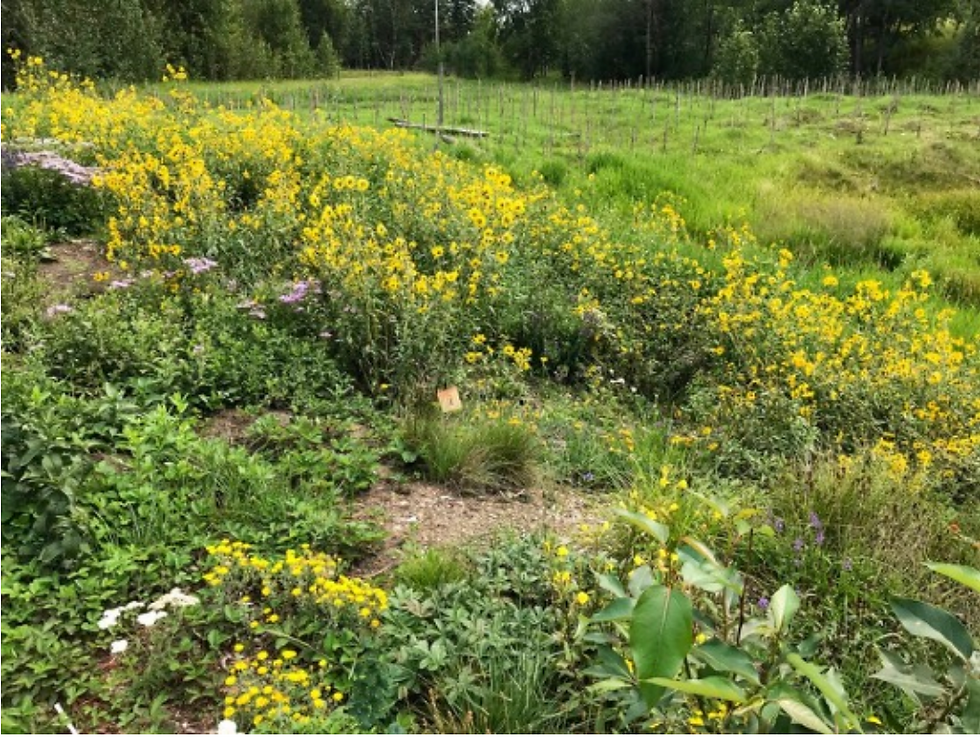
There were also no goldfinches on the sunflowers. However there are very few seed heads as yet, just hundreds of flowers.
Is it possible to have too many sunflowers?
August 14th
Another really hot day.
Margriet mulched the top edge of the wetland side and we dug out some of the hedge nettle that was threatening to smother the blue-eyed grass and transplanted it into the grass close to the pond. It is a rhizomatous native wetland species, so it should be able to compete with the grass there.
David dug some holes on the wetland side so that water flowing down the steep slope would be collected and would sink in. He also put a log barrier below the patch of false dandelions, to stop water from flowing away from their roots and give them more water. I want to add more log and water breaks in the future.

When we did our walkabout on the prairie side the Indian ricegrass plant was in seed so I was able to take a photo. This is a rare plant and I am hoping to grow out more, because it prefers dry sandy conditions, so it would be perfect for Bunchberry. My fall project is to finish taking out the invasive grass on the borders of the prairie side so I can plant more native grasses.
August 21st
Pond levels are above normal thanks to all this rain. So great to see! There were some mosquitoes, but not too bad.
It was a wonderful day for planting, with a few days of rain forecast to settle the plants in. So that was my focus, and Margriet and I managed to put in about four trays of plants that had been cluttering up my back yard - only another 12 or so trays to go!

Margriet and I had a surprise as we were leaving.
We were packing up my car and I noticed a small hole by the wetland side fence line that hadn’t been there before. A northern pocket gopher had built it while we were working. As I went past it to get more stuff I noticed the hole now had a pile of dirt half way down - there was an active pocket gopher down there! Margriet and I stopped and watched, and sure enough a little nose and some teeth appeared pushing the pile of soil. It was my first sight of a pocket gopher as they normally spend most of their time underground. I stayed still and after a while it poked its head out as it pushed out the soil and then it started to come almost all of the way out to grab a leaf or two. It was in a patch of hedge nettle and seemed to enjoy the leaves as well as the roots!
September 8th
Finally the smoke is clearing.
It’s seed collecting time, so there were lots of gaillardia, golden-aster, slender blue beardtongue, blue-eyed grass, spotted Joe Pye weed, pink corydalis and lilac-flowered beardtongue seeds ready for collection. Also some nodding onion and false dandelion.
Sue P. is collecting smooth fleabane and low milkweed from her land as we have very little. The Bunchberry Meadows milkweed patch had a bad year this year and didn’t produce any seeds. I planted low milkweed seedlings from the Bunchberry population on the wetland side this year and I will add more next year. I am working towards building a robust population in the plot as the original patch in the meadow is doing so poorly.
September 12th
We had so much fun today that I didn’t get everything done so I am going back tomorrow, Wednesday, to finish.
Sue P. and I went for a walk to collect harebell seeds and northern gentian seeds and also look at the grape ferns. There were a lot of Northern Gentian plants in seed and surprisingly, several plants in bud and about to flower. The interesting thing about this population is that many of the plants have white flowers instead of the usual blue colour.

There were so many grape ferns I couldn’t count them all, and if you brushed one a small cloud of spores floated off. We were trying to figure out how to grow out plants from the spores. Sue found instructions on Google once she returned home, so that might be a project for next spring. Sue has already found some tiny ferns that selfseeded in a neglected pot on her property.
There were so many harebell seeds that I spent too long collecting them and when we came back we found Liz talking with a new person. Her name is Alia and she introduced herself as the Nature Conservancy of Canada Ecological Restoration Manager for the whole of Alberta! So I had to show her some of our treasures and rare plants.
September 13th
There is a ground wasp nest in the mulch pile close to our sitting area. Sue P. discovered it, but unfortunately a wasp discovered Sue first and she got stung.
They are normally very docile, but Sue was weeding out giant Russian pigweed plants and disturbed the soil close to their nest. I have put a flag next to the entrance so people don’t go too close and disturb them. They haven’t bothered us while we have been eating and they are not bothered by people just walking by.

There are still lots of butterflies on the gaillardia on the wetland side, and lots of gaillardia are still in bloom. The lilac-flowered beardtongue nearby has plenty of seed heads but is also in bloom again The common tall sunflowers are now dormant, so it is time for the great sunflower giveaway.
Next week Kayleen from Edmonton and Area Land Trust is coming out to take some common tall sunflowers to put in at the Smith Blackburn property.
Sept 18th
What a great day! It was wonderful weather and Kayleen and her helper swiftly dug up a large number of common tall sunflowers. Liz cut off the top growth and distributed the seed heads around the pond so more plants could germinate. She also took some seedlings home to grow out for future projects.
David brought his friend who was visiting from B.C. and they tackled the carpets of yellow evening primrose seedlings. It is amazing how much yellow evening primroses can self-seed.
Sue P. and Susan W. tackled the invasive grass along the perimeter of the prairie side. Now I have a clear space to plant the sun sedges and other dryland sedges waiting to go in.
September 25th
Sue P. brought her grandson to help us create a big pit for compost on the prairie side. Now that it is full we have a large amount of compost available on site. This is needed because the sandy subsoil on the prairie side is so poor that some plants are only a third of their true size.
We discovered an interesting grass close to the compost pit. The seed head looked like smooth brome, and the leaf had the distinctive W sign, but the leaves and stem were very hairy. I would love to find out what it is as I have never seen this grass before.
Liz and I were able to plant some grasses on the wetland side and on the prairie side so I am making progress with fall planting. We were lucky that we had great weather.
On the wetland side there is now a wonderful wide strip of bare soil where the common tall sunflowers used to be. Several healthy meadow blazingstar plants were uncovered! We will definitely have another sunflower giveaway in the spring and it will also be time for a Canada anemone giveaway too.
Fall wrap-up
I don’t know how much longer we can work this year - it will depend on the weather, but I am hoping to keep going until the end of October.
I want to mulch everywhere before winter and spread leaves again on the prairie side. I still have quite a few plants to put in and quite a few patches of invasive grasses to take out.
Speaking of grass, the sweet grass is magnificent; it seems to like being an understory crop for the sunflowers. There will be plenty to give away to volunteers next spring.
I am so grateful to my wonderful “Bunchberry Bunch” volunteers. I would not have been able to achieve the transformation that has happened so far without their support, encouragement and hard work!
Next year the adventure will continue!
Editor’s Note: Bunchberry Meadows Conservation Area is about a 20-minute drive from the west end of Edmonton, down Fleming Road. It has an extensive system of trails, dry toilet facilities, and picnic tables on site. Located in the Devon Sand Dune system, it is worth visiting at any time of the year. https://www.ealt.ca/bunchberrymeadows
PLEASE NOTE: Bunchberry Meadows is currently closed to the general public, but will reopen on October 31, 2023. Guided tours will be available, prior to this date, through the Nature Conservancy of Canada. Please see “Events” above for the link to register for those tours.


