
Grasses of the Badlands. Part 8

Originally published in the August 2022 issue of the WildFlower News
By Patsy Cotterill

In this session I will take a look at some of the grasses that occur in our badland habitats, geological formations of clay and sand that have been formed by erosion of geological strata by rivers. They provide an opportunity for the expression of a grassland flora that is more characteristic of the southern prairies, and that is more particularly confined to clays slopes. I’ll make particular reference to a local badlands escarpment which we’ve named Gibbons Badlands Prairie, but some of these species can also be found in the North Saskatchewan River valley in Edmonton.
Blue grama, Bouteloua gracilis


Let’s start with an easy one first. Blue grama is so distinctive that most people can recognize it immediately by eye. It is a low, tufted perennial with rhizomes that allow it to form a dense, lawn-like sod in suitable habitats. Its narrow leaves characteristically curl, giving it another moniker as a main component of “prairie wool” in which it constitutes an important forage grass, tolerant of grazing. The flower stalks bear one or two spikes at the tip, which are comb-like, 1.5-4 cm long and usually purplish. The hairy, 4-6 mm, spikelets are densely packed in two rows on one side of the horizontal spike stalk, giving rise to the popular name of “eyelash grass,” although in fact they look more like tiny brushes. The spikelet looks purple because of the long, pointed upper glume, and each contains one fertile floret with a membranous lemma of 3.5-6 mm, whose five lobes are capped by tiny purple awns and which is white-hairy at the base and along the midvein, and one (sometimes two) sterile floret(s) with a lemma that is shorter, but whose three purple awns are longer, as are the basal hairs.
Western wheatgrass, Pascopyrum smithii


Left: western wheatgrass (Pascopyrum smithii) colony on grassland slope in Gibbons Badlands Prairie, 2022.07.25. Photo: P. Cotterill.
Right: single spike of western wheatgrass In same area. Photo: Toni Ross.
This is a distinctive, grey-blue-coloured member of the wheatgrass tribe (Triticeae) that readily colonizes badland slopes, gullies, and other ground with diminished vegetation by means of rhizomes. It is a conspicuous presence in Gibbons Badlands, and flowers in July, its long (4 mm) anthers dangling attractively from blue-green spikes held up to 60 cm above a tuft of similarly coloured flat or inrolled leaves. The spikelets on either side of the (5-17 cm) spike stalk are rather closely arranged and overlapping, each about 2 cm long and consisting of 6-10 florets. The glumes are about 10 mm long, narrow, rigid, stiff, keeled, prominently nerved, broadest towards the base, straight-sided and tapering gradually to a point, with the midvein curved to one side; each is only somewhat shorter than the adjacent lemma. The lemmas are usually hairless if a bit rough to the touch and usually have a short awn at the tip. I dwell on these characters of the glumes and lemmas because they can be important in distinguishing western wheatgrass from another common grass of badland habitats, northern wheatgrass or northern wildrye, Elymus lanceolatus. This grass can have bluish foliage, but its spikes appear less congested and thinner as the spikelets are more loosely arranged and have generally fewer florets (4-8). Its glumes of 5-8 mm are in contrast flat or rounded on the back, broadest above the middle from which they taper more abruptly to a point, with a straight midvein, and are mostly about half to three-quarters the length of the lemma. The lemmas are awnless to short-awned and can vary from hairless to densely hairy depending on which of the three recognized subspecies the plant belongs to. These are subtle differences between the two species that require some magnification and experience to interpret. I suspect there may be differences in flowering time at Gibbons Badlands Prairie which could be worth investigating as an aid in identification.
Both are wide-ranging species across North America in appropriate habitats, although they may be more abundant in the West.
Sandgrass/prairie sandreed/sand reedgrass, Calamovilfa longifolia/Sporobolus rigidus
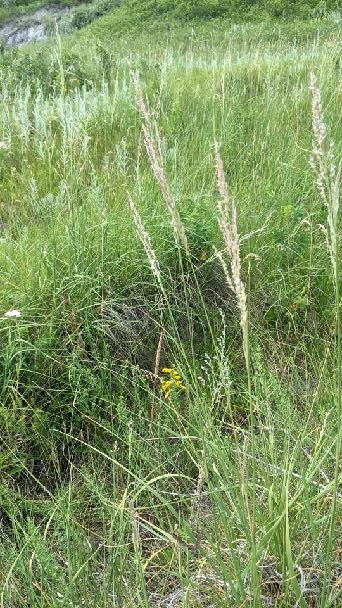

Left: sandgrass, Calamovilfa longifolia, colony on badland slope, Gibbons Badlands Prairie, 2022.07.25.
Photo: Manna Parseyan.
Right: close-up of panicle branches of sandgrass showing open flowers with stamens and stigmas. Photo: P. Cotterill.
I personally continue to use the scientific name Calamovilfa longifolia for this species. This is a break with my usual practice, which is to follow the Canadensys Vascan database, and hence the Kershaw/Allen key guide which is based on it, where these differ from the Flora of North America treatment (which in this case retains C. longifolia). This name is descriptive, even the “Calamo” portion suggesting a similarity of the delicate panicle of sandgrass to that of Calamagrostis, but more than this, the plant is so distinctly different from the species of Sporobolus that I know, S. cryptandrus, sand dropseed, that it stretches credulity to believe they are in the same genus, at least morphologically. Likely this is an example of nostalgia rather than good science, but some of these taxonomic name changes are indeed shocking!
Sandgrass is a perennial grass that sends up its tall fertile shoots in late summer but can be recognized much earlier by the distinctive, bluish-green colour of its abundant, long leaves that tend to bend over. It spreads chiefly by elongate rhizomes which bear shiny, hard, scale-like leaves and allow the plant to form colonies on the sandy soils it favours or on sandy outflows in badlands terrain. It functions as a binder of sand dunes. The branches of the panicle (up to 30 cm long) are erect or ascending, and support narrow, awnless spikelets that contain a single floret. The thin glumes, pale at first but later becoming purplish or brownish, roughly equal in size and at 4-7 mm long similar in length to the lemma and palea, have prominent midveins (perhaps the source of its new species name?). A dense tuft of white hairs at the base of the floret persists in the grain, aiding seed dispersal.
Sandgrass occurs across Canada from the west as far as Ontario, and in the central U.S. except for the southeast and southwest. Locally it is common in Fort Saskatchewan Prairie and on the badland slopes in Gibbons Prairie. A wish of mine is that all the smooth brome in Fort Saskatchewan Prairie could be replaced by sandgrass, a restoration project that might even be feasible given the resources. Unfortunately, things tend to go the other way. A dense stand of sandgrass was removed when a portion of the asphalt surrounding trail was constructed. The sandgrass did not recover and was replaced immediately by, guess what, smooth brome, a grass that takes advantage of the slightest disturbance!
References
https://www.minnesotawildflowers.info/grass-sedge-rush/blue-grama https://www.minnesotawildflowers.info/grass-sedgerush/sand-reed-grass Flora of North America. Bouteloua gracilis. Vol. 25, page 261.
Flora of North America. Calamovilfa longifolia. Vol. 25, page 141.
Flora of North America. Elymus lanceolatus. Vol. 24, page 327.
Flora of North America. Pascopyrum smithii. Vol. 24, page 351.
Kershaw, Linda and Lorna Allen. 2020. Vascular Flora of Alberta. An Illustrated Guide. Self- published. Kindle Direct Publishing.
Moss, E. H. 1983. Flora of Alberta. 2d ed. edited by J.G. Packer. University of Toronto Press, Toronto.


