
Oleskiw Observations: Bedstraws, Poison Ivy and Others

Originally published in the August 2022 issue of the WildFlower News
by Hubert Taube. All Photos by author.
In the September 2021 issue of the Wildflower News I reported on my observations of three native bedstraw species: Galium boreale, G. triflorum, G. trifidum and the non-natives G. verum and G. mollugo, the last one being a tentative identification.
I can now add the non-native cleavers bedstraw, G. aparine, and the native Labrador bedstraw, G. labradoricum, to my lifelist.
I found G. aparine in built-up neighbourhoods close to my house: one in Oleskiw Park, a city designated tableland natural area, presumably an escape from a neighbouring garden and another along a fence line separating a residence and a sidewalk.

On a trip to Kilini Creek Natural Area (PNT), walking towards Golden Pond, I had my first encounter with Labrador bedstraw (also called bog bedstraw), G. labradoricum. This species closely resembles three-petal bedstraw, G. trifidum. A distinguishing feature is the number of petals: three for G. trifidum and four for G. labradoricum, although on some occasions the reverse can also be true.


L. Labrador bedstraw, G. labradoricum, patch, Kilini Creek NA, 2022 07 04
R. Labrador bedstraw, G. labradoricum, detail, Kilini Creek NA, 2022 07 04
I’m keeping a close eye on the so-called G. mollugo observations in my neighbourhood; in particular, on the Wakina patch and on a new quite extensive patch on the Oleskiw Slope trail.
Currently (end of July 2022), the Oleskiw Slope patch shows prolific flowering and fruit development while the Wakina patch (being in a dark, less exposed area) has no signs of flowering.
The River Valley Oleskiw area (between the Ft. Edmonton and Terwillegar footbridges, on the “northside” of the river) appears to be host for a number of rare-to-Alberta invasives: Burnet saxifrage, Pimpinella saxifraga, Lady’s bedstraw, G. verum, and the presumed hedge bedstraw, G. mollugo. We (Patsy Cotterill and myself) speculate that these weeds were introduced by the former Oleskiw hayfield farmer having hayseed imported from England.


L. Burnet saxifrage, Pimpinella saxifraga, Oleskiw gravel trail, 2022 07 23.
Above and R. Hedge bedstraw, G. mollugo, Oleskiw dirt trail, leaf arrangement, flower heads, and young seedheads, 2022 07 23.
I distinguish three parts in the Oleskiw area: Oleskiw Woods, the tree covered area along the river; Oleskiw Meadows, the wide-open abandoned hayfield to the west; and Oleskiw Slopes, located between the Ft. Edmonton footbridge and Wolf Willow Creek.
The initial observations of G. verum and P. saxifraga were along the edge between the Oleskiw Woods and Meadows; but now I see them also on the Oleskiw Slopes and beyond on top-of-bank locations. As a matter of fact, I have seen both species in River Valley Cameron on trails near the E L Smith Water Treatment Plant, an area now made inaccessible by the Solar Farm; and I believe there are also reports from Terwillegar Park.
And now to observations of the poison ivy:
When talking about poison ivy, Toxicodendron rydbergii (also called T. radicans) to Edmonton residents, who have some acquaintance with southern Manitoba, you frequently hear the comment: “Aren’t we are lucky that we don’t have poison ivy here”. Examination of iNaturalist records for Alberta seem to confirm this.
This assessment was generally true for myself as well … until the fall of last year. Now, however, I no longer agree and I feel that Oleskiw is a veritable hotbed for this species of concern. I’m very surprised that I haven’t noticed this during all my wanderings through the Oleskiw valley in last 20+ years.
Anyway, I made one observation late last year and then I followed up with further investigations during July 2022. I noticed there is extensive spread all along the Oleskiw slopes: from the uplands near Woodward Crescent, along the gravel track into the valley and, in particular, an almost continuous spread along the Oleskiw Slopes trail (recently cut by a mountain biking group, unauthorized?).
The question arises if the mountain biking activities have in fact contributed to this extensive invasion. If so, some limitations should be placed on further expansion of mountain biking trails.


Poison ivy, Toxicodendron rydbergii,
L. mature seedhead, Oleskiw dirt trail, 2021 11 06.
R. leaves-of-three, Oleskiw top of bank, 2022 07 14.
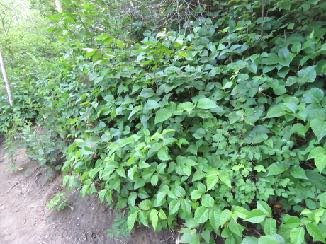

L. extensive spread, Oleskiw dirt trail, 2022 07 14.
R. young fruit, Oleskiw dirt trail, 2022 07 14.
As before I encourage all readers to provide comments to the WN editor; in particular, about the “discovery” of G. mollugo as a new species for Alberta.


