
Two Spring-flowering Plants that are Good for the Garden
By Patsy Cotterill
Prairie crocus (Pulsatilla nuttalliana) and three-flowered avens (Geum triflorum) are both spring-flowering grassland plants with a number of features that make them welcome in the native plant garden.
Although they belong in different families, prairie crocus in the buttercup family (Ranunculaceae) and three-flowered avens in the rose family (Rosacea), they have similar flowers with a simple, radially symmetrical arrangement of sepals and petals. They both also have a ring of numerous stamens surrounding a central cluster of separate pistils, characters that are considered fairly primitive in the evolutionary scale of things. (A pistil consists of stigma, style and ovary.) It is when the latter have turned into fruits that the resemblance is really striking, because in both species the ovaries develop into a head of numerous, one-seeded fruits called achenes, each topped by an elongated feathery style that is also known as an awn. In both species these fruits are destined for dispersal by wind, detaching when they are ripe and being blown across the open prairie.
Prairie Crocus, Pulsatilla nuttalliana
Prairie crocus is one of the most popular of Canadian wildflowers; it is both beautiful and a welcome harbinger of spring after a long winter. To the botanist, it is of interest because of its intriguing life strategy.

In April, using food reserves stored in its woody taproot to fuel growth, it pushes up bobbin-like flower buds enclosed in furry, brown sheaths. Just centimetres above the ground, these will open into the bowl-shaped white, blue or purplish flowers that look a bit like starry clusters amid the flattened, winter-killed grass. The flowers are protected from cold and drying winds by their ground-hugging stature and the ruff of hairy modified leaves (called

an involucre) attached below the short flower stalk. The shallow dish shape of the flower works to concentrate the sun, which reflects off the petals (technically sepals) warming the reproductive organs (the stamens and pistils), and any early-flying insects that come to feed and shelter inside the flower. The flowers are also heliotropic, following the sun around the sky, a phenomenon that also raises the temperature within the flower. As the days go by, the sepals wither and fold up (often becoming more crocus-like and a darker hue), shielding the ovaries as they develop into achenes. The feathery styles attached to the ovaries also lengthen, from 2 to 4 cm, ready for their role in seed dispersal and planting!

Leaves and fruits develop simultaneously
The flowering (now fruiting) stalk elongates, keeping pace with the growth of green grassland vegetation around it. At the same time the true leaves come up on separate, long stalks. They are broad but divided into many narrow segments, most likely the better to minimize water loss in a dry prairie.
Seed dispersal and afterwards…
While prairie crocus can spread in girth as the plant matures, it can only reproduce and establish itself elsewhere by seed, so this extra self-sowing technique is an advantage in penetrating prairie turf.

Senescence
By mid-July the leaves of prairie crocus are starting to wither and curl up, and the achenes have detached from the head and floated away. (Sometimes, however, they get clumped together by rain and persist on the plant.) By now the leaves have produced enough food to refurbish the taproot and allow for re-growth the following spring, and the plant becomes dormant and disappears underground.
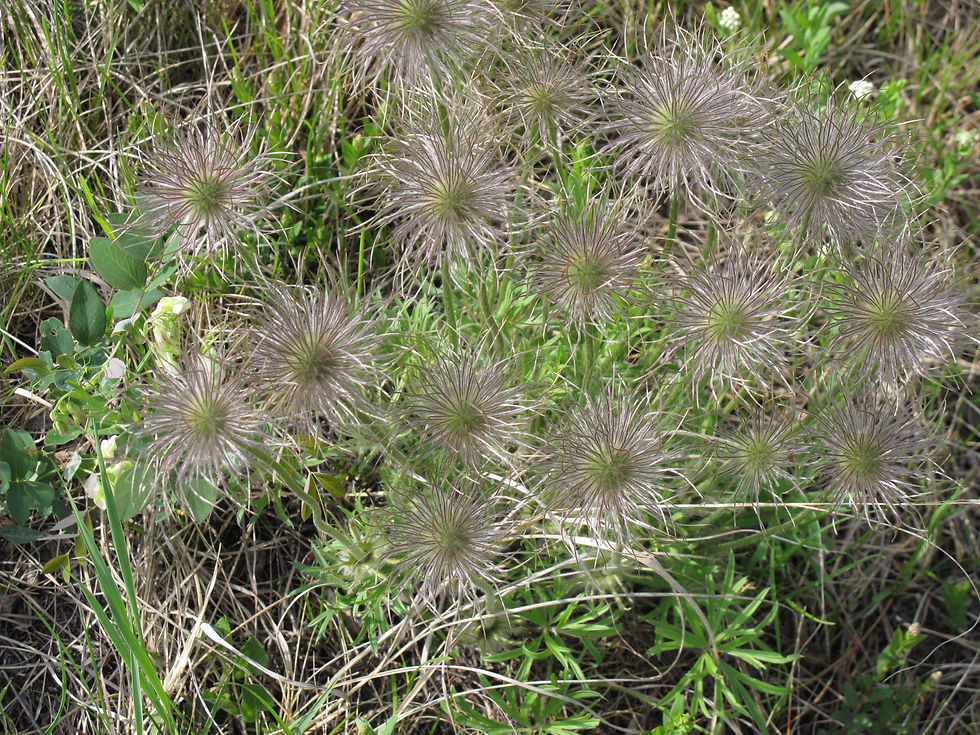
The anti-competition strategy
Essentially the life strategy of the prairie crocus is to avoid competition with other plants by emerging early and completing its seasonal life-cycle by mid-summer. Other benefits are that it avoids the worst of late summer droughts and takes full advantage of the cohort of early-emerging pollinators. Beating the competition as an early bird does have its hazards, however. Severe late frosts can kill the reproductive organs or interfere with pollination, putting the hex on the seed output of a population for a year. While many species make use of stored reserves to promote early flowering, to avoid pollinator competition, aid in wind dispersal of early fruits or to allow a longer time for fruit development, few native herbaceous plants are quite as early as the crocus.

Growing prairie crocus
Unfortunately, prairie crocus has a reputation for being slow to germinate and even slower to grow. It can take a few years to become robust enough to produce a good show of flowers. The experts say that its seedit must receive cold moist stratification (either indoors in the fridge or outdoors) and is best planted in a well-drained, sandy medium. Since in nature our local crocus populations occur on sandy soils, or often on slopes or knolls in grasslands, it will be a good idea to keep the species in a well-drained spot in the garden. Check out this link for more information: : http://www.naturenorth.com/spring/flora/crocus/Prairie_Crocus2.html
The common name is a misnomer!
Finally, a word about its name. It was called crocus by the early farmer settlers because of its resemblance to the European crocus in the iris family (the plant that has a bulb). Botanically, this is misleading because it is really closely related to the Anemone genus in the Ranunculaceae. Indeed, it was for long known as Anemone patens, first described by Linnaeus, before its (final) transfer to the related Pulsatilla genus. Pulsatilla means pasque flower, which is appropriate given its flowering time, while its species name nuttalliana honours the celebrated botanist Thomas Nuttall who explored the American prairies in the early nineteenth century. The only other Pulsatilla member in Alberta is the beautiful alpines species, western anemone or western pasqueflower (Pulsatilla occidentalis), which flowers much later, as you can imagine in high-elevation habitats, but otherwise bears considerable resemblance to its prairie cousin.

Three-flowered avens, Geum triflorum
This prairie member of the avens genus, Geum, flowers in mid to late May in our Parkland climate, sending up softly hairy stems to 20-40 cm from a cluster of basal leaves, which are anchored in turn by a stout rootstock. It is an easy plant to recognize: nodding deep pink flowers arise, usually in threes as its name suggests, on drooping flower stalks from a node at the top of the stem. The plant stakes its claim to space by means of its prostate to slightly upturned basal leaves which are typical of avens species in being long and divided into opposite, paired leaflets of different sizes.

Distinctive flowers
Pointed bractlets and shorter sepals contribute to the bright pink of the flowers; the petals on the other hand, which face downwards in a ring protruding from the cup, are cream to pale pink. As in prairie crocus, the stamens are numerous, and surround a central cluster of separate, one-seeded ovaries that will produce the achenes.
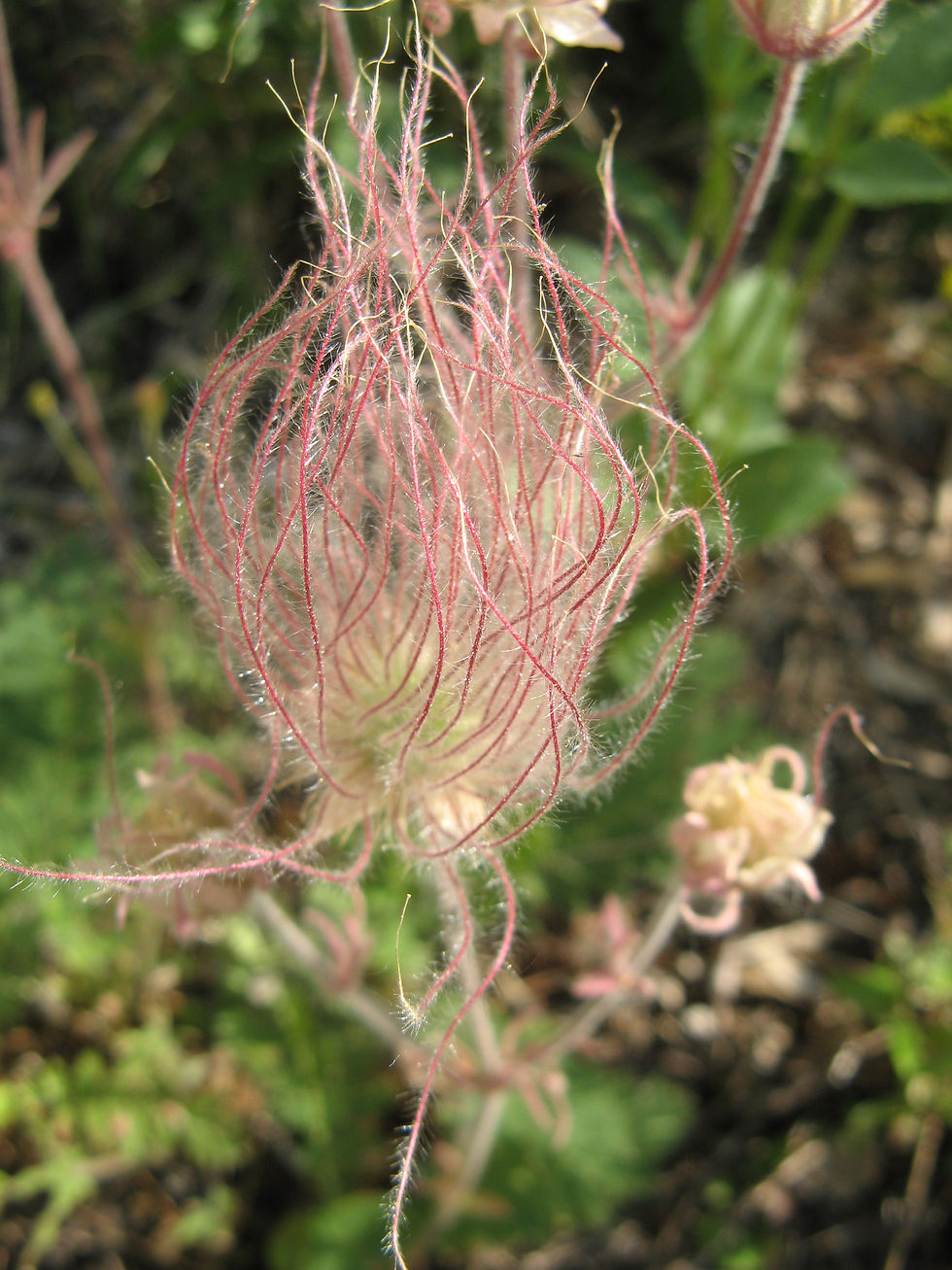
Fruiting heads that look like prairie smoke!
With regard to seed dispersal, three-flowered avens employ a similar strategy to that of prairie crocus. The styles topping the achenes elongate to 2-4 cm; they are red, and covered in pinkish hairs. Together they form a feathery seed-head that resembles a flaring torch, and give rise to the plant’s other two common names, prairie smoke and old man’s whiskers. The effect is heightened because as the fruits develop the flower stalks straighten, holding the achene heads upright and aloft in the wind.
Three-flowered avens prefers somewhat moister grassland than prairie crocus, a trait it shares with other avens species. In drought conditions later in the summer, the basal leaves can be seen to curl and wilt. As with prairie crocus, this species enjoys a wide distribution in grasslands across Canada.
A worthy member of the native plant garden
Relatively easy to grow from seed, three-flowered avens makes an excellent plant for the native garden on several counts: early flowering, basal rosettes of attractive leaves which provide good ground cover, and a relatively long period of flowering that is extended by an equally attractive fruiting season. It can be recommended as a good border or edging plant.
Both prairie crocus and three-flowered avens can be seen locally in Fort Saskatchewan Prairie, Nisku Prairie, and Gibbons Badlands Prairie.
References
Canadensys Vascan:
Geum triflorum https://data.canadensys.net/vascan/taxon/8775?lang=en
Pulsatilla nuttalliana https://data.canadensys.net/vascan/taxon/30377
Kershaw, Linda and Lorna Allen. 2025. Vascular Flora of Alberta: An Illustrated Guide. Second Edition. Self-published. Kindle Publishing.
Moss, Ezra H. 1982. Flora of Alberta. Second edition edited by John G. Packer. Toronto. University of Toronto Press.


