“Combative Stewardship” – The Invasive /Herbicide Debate: Some Points of View
- jessica36732
- Dec 8, 2025
- 11 min read
The following short article appeared in the October 3, 2025 newsletter of the Edmonton River Valley Conservation Coalition (ERVCC) (http://eepurl.com/joInYE):
Blackfoot knowledge-keeper Ryan First Diver has posted many videos on YouTube as part of his phenology course in Lethbridge. This past summer one of the videos he posted deals with "combative stewardship."
This is the term he has given to land conservation that labels plant or animal species “invasive” or “noxious.” He reminds viewers that these labels come from the industrial agriculture industry (which ignores, for example, that by their own definition, canola should be labeled an “invasive,” “noxious” plant, but is not). He urges a move away from “the war trope” toward other ways of talking about the land that reflect peaceful co-existence. ERVCC notes that labeling plants “invasive” or “noxious” offers justification for pesticide use, some problems of which are listed in the section above.
How else might we talk about plants like dandelions or creeping bellflower? We could say they are “introduced” plants rather than “invasive.” We could observe their pioneering role in soil remediation in some places, and the way they later make way for native plants after a few years. We could observe their role in feeding pollinators. We could ban pesticides and undertake pulling by hand. In some cases, we could eat them. We could love how beautiful they are. And, as Ryan says, we could learn from them what their knowledge gifts are. This change in language is necessary for any meaningful decolonization of conservation to take place.
This article elicited a number of responses from the local botanical community.
The reply to the Edmonton River Valley Conservation Coalition from Kristyn Mayner, Secretary of the Alberta Native Plant Council.
I hope this message finds you well. I enjoy reading ERVCC's newsletters and especially appreciate all the diligent advocacy your organization does on behalf of Edmonton's natural areas. As an avid gardener and professional ecologist, the stance on accepting creeping bellflower as a beneficial plant in our urban ecosystems irked me! Hence here are my thoughts on stewardship that allows our natural areas to thrive, which admittedly takes a little bit of combativeness.
I can see why the terms invasive and noxious are charged and there is a desire to avoid the negativity of this language. In my view, however, the strength of the language reflects the severity of the threat these species can pose - not only to agricultural systems but even more so to our natural ecosystems. Here are some key reasons why these terms are needed:
They provide a clear, widely understood signal that these plants spread aggressively, outcompeting native plant species and leading to overall biodiversity loss. This helps land managers quickly identify priorities for management, i.e., there is more likely to be a rapid response when we're tackling a noxious weed infestation versus when tackling "introduced species with high reproduction rates."
These terms are embedded in laws and policies such as Alberta's Weed Control Act and International Union for Conservation of Nature (IUCN) frameworks, allowing for alignment and funding opportunities. Without this language, how do we signal or prioritize where action and enforcement are needed?
Using these strong labels also emphasizes the urgency of protecting native plant ecosystems, mobilizing action before irreversible damage occurs. They are more likely to be effective in raising awareness and motivating behavioural changes. In fact, second to tree planting, I think that weed pulling events are some of the most common stewardship events that occur in natural ecosystems in and around Edmonton (EALT, NCC, Wagner, etc.) — people love to get out and feel like they're making a positive difference and I would never want to discourage their efforts!
I realize that the crux of the issue is the use of herbicides to control noxious weeds. I wouldn't claim to know enough to make the call of when herbicide is needed versus when manual management (weed pulling) is effective, but I think that the audience of your newsletter should not be discouraged from passively managing weeds on their properties — especially creeping bellflower! — before they spread to our natural areas. Hence, some combativeness is healthy for maintaining the ecological integrity of our ecosystems. Otherwise, what stewardship actions are we taking beyond being passive observers and advocates?
Please let me know if I might contribute further information on the invasiveness of some plants of concern in the Edmonton river valley — creeping bellflower, tansy, caragana, to name a few. I could also offer insights into beneficial plant species that gardeners might plant to support pollinators much more effectively than introduced species.
Response by Patsy Cotterill of ENPS:
I make the assumption that “combative stewardship,” particularly combatting invasive species, is being opposed because it involves the use of pesticides/herbicides which are associated with European agriculture and therefore is a sign of colonialism.
Since most of our invasives are non-natives that were introduced during European settlement either accidentally or deliberately for agriculture or horticulture, or to a lesser extent through travel and trade, they could of course be considered the results of the colonization of North America. (Hence combatting them could be thought to strike a blow against colonization, could it not?)
Most of our introduced plant species, invasive or otherwise, behave as weeds, growing in disturbed ground resulting from human activity, such as fields, gardens, transport corridors, trails and waste ground, with some qualifying also as ecological weeds if they infiltrate natural ecosystems from these sources.
There are “weedy” native species, of course, plants with high rates of reproduction or regeneration adapted to growing in areas that have been laid bare by natural causes such as flooding, erosion, uprooting of trees or animal disturbance. Such plants are not usually considered invasive. For example, fireweed spreads rapidly after forest ground cover has been removed by fire. However, the native colonizer spreading dogbane may be labelled a weed by farmers tilling fields on the sandy soils it loves.
While some scientists have denied that biotic invasiveness is a problem, this is not the consensus. Rather, it is considered a major factor causing the loss of biodiversity in this current epoch of the Anthropocene. It is true that some of these foreign species settle down as naturalized immigrants and become law-abiding members of native communities, with pollinators and herbivores adapting to them, but others remain invasive, incurring huge ecological and economic costs.
Hence “invasive” as it refers to plants and animals is an ecological term denoting plant or animal behaviour that has negative consequences in economic or ecological terms. It should have no cultural or political connotation. In ecological terms, invasive species do damage by infiltrating and colonizing natural ecosystems, replacing native species, and reducing natural biodiversity.
My perspective on both invasiveness and herbicides comes from my efforts at partial restoration in two grassland remnants, in Nisku and Fort Saskatchewan, as well as my observations of weeds in a variety of situations. Despite the presence of several native grasses, and a greater variety of forbs, the main ground over at these two sites is of the non-native grasses Kentucky bluegrass and smooth brome. Their cover is so great that the only practical way of controlling, let alone eliminating them, given that manpower is always limiting, is to use herbicide. The right herbicide, used in the right quantities and at the right time in the plant’s seasonal cycle, effectively kills the roots and rhizomes. Removal by pulling or mowing, although it will work for annual weeds in small areas, is likely to stimulate compensatory growth in perennials.
Clearly, natural controls are preferable to synthetic chemicals, and research continues to find effective biological controls, but these rarely serve to wipe out large populations; rather in nature they serve to keep populations in check.
As a practitioner who sees the need for herbicides I am therefore not best pleased by campaigns that influence public opinion with the aim of getting municipalities to ban them. Such campaigns are usually based on considerations of human health, without taking into account biological situations where herbicides are necessary.
We should balance the risk of using a powerful herbicide against the risks, economic and ecological, of not controlling weeds and so we should practice discrimination. In the case of dandelions, for instance, it may be necessary to get rid of them in natural areas, high-profile landscapes, golf courses and playing fields, but not necessarily along roads or trails, or in hay fields or orchards. Lawns that have become severely infested with dandelions should either be re-sown or re-sodded, or else replaced with a different type of landscape altogether.
Incidentally, there are interesting local examples in several of the City of Edmonton’s constructed wetlands where invasive non-natives have been deliberately planted to provide quick ground cover and erosion control, in which case they are not considered weeds. Cicer milk-vetch, alfalfa, bird’s-foot trefoil and tufted vetch pioneer on bare ground far more effectively than native legumes do. Such is the City’s rush to obtain ground cover that more slowly establishing native plant mixes are discounted. Unfortunately, such plantings for reclamation mean higher populations of invasives that are able to enter natural ecosystems and remove opportunities for native plantings.
In the Edmonton Native Plant Society our “combative stewardship” consists in trying to equalize the battlefield for native plants, which are usually on the losing side where human settlement is concerned!
Daniella Liknes of the ENPS explains why she considers European buckthorn (Rhamnus cathartica) a good example of an invasive plant that should be recognized as such:
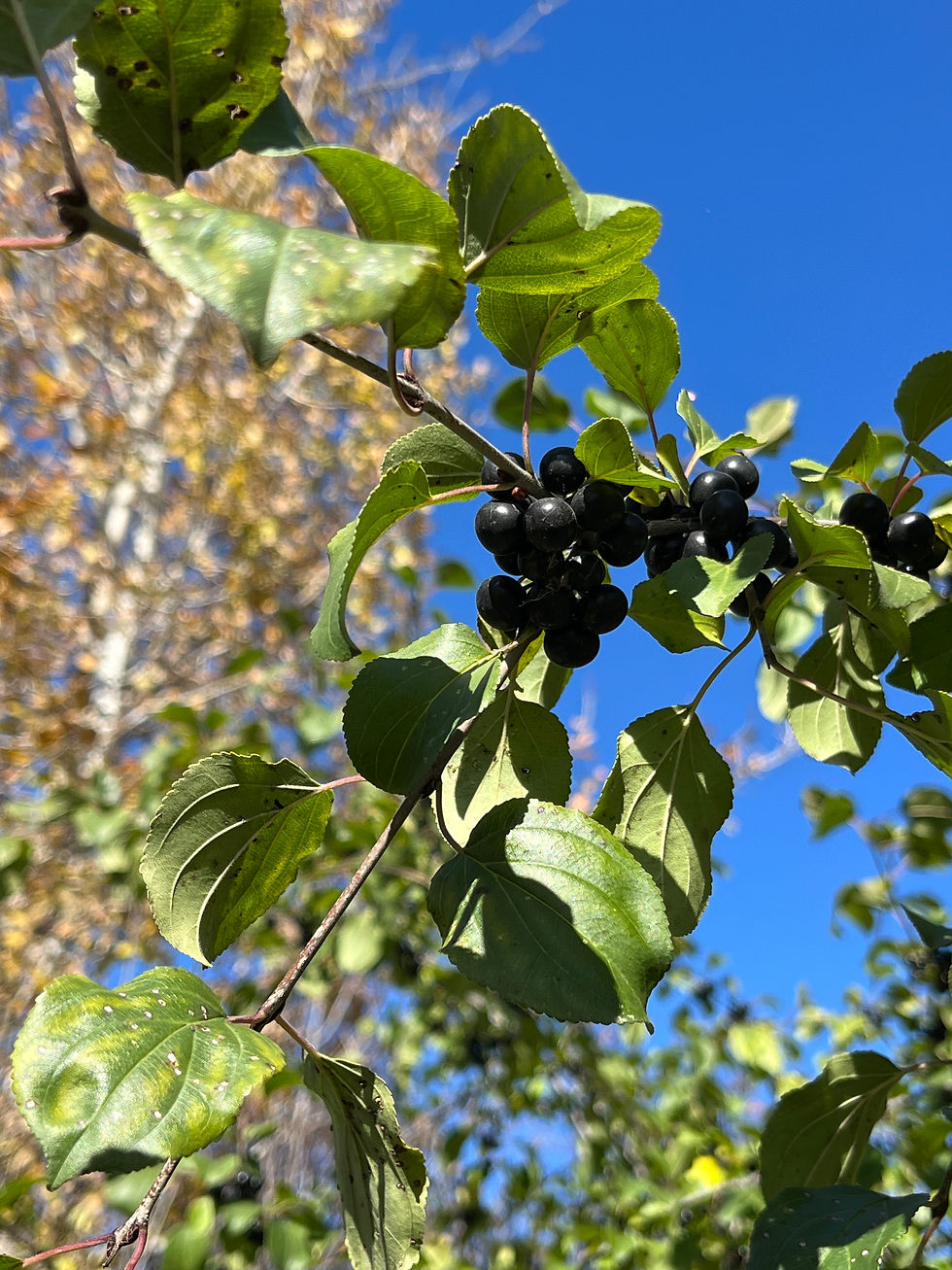
I had the wonderful opportunity to volunteer with ERVCC in August at their Dawson Park tree planting event. While the group was planting those trees, I spearheaded the effort on removing the invasive shrub European Buckthorn. I’d love to talk about why that was necessary, and how practising stewardship and reciprocity involves managing our wild spaces for invasive species removal while encouraging the increased spread of site-appropriate native plant species.
I didn't get a chance to explain in person why I was so insistent on the removal of buckthorn while we planted, and I wanted to clarify some important nuances that I believe got left out of the public discourse on invasive species as I read them from the latest (ERVCC) newsletter.
An important question to ask ourselves is what exactly are invasive species. An invasive species is a non-native organism that, when introduced to a new ecosystem, causes ecological and economical harm. It’s important to note that non-native is not synonymous with invasive; there are many time-tested “well behaved”ornamental plants, for example, that do not escape their plantings or cause problems. Invasive species are one of the top causes for biodiversity loss (extinction) across all kingdoms of life. The most harmful of these tend to be from different continents entirely, where they have evolved with so-called checks and balances that are not present in North America. These include native diseases and pathogens and insect hosts and predators, as well as competition and herbivory via other plants and animals.
Some of the harms that are caused start at the bottom of the food web. Plants native to an ecosystem, like our asters and goldenrods, native grass species, or fruit/seed-bearing plants, are the base of that particular food web. The next step up of the food web is insects, the little beings that run the world. Native plants have evolved over millennia with their insect pollinators, and their relationship doesn't just end at pollination. 90% of all insects are specialists, meaning they can only eat or feed from a certain genus of plants. One such genus is Solidago, the goldenrods. Solidago supports over 100 types of specialist caterpillars, which unless they survive go on to be bird food, food for other bugs, and food for rodents. This energy exchange echoes up the trophic levels, which include mammals such as ourselves.
In the case of European Buckthorn specifically, because it did not evolve here, it loses its leaves later than our native deciduous trees do. In the spring it also leafs out before most of our natives, getting a leg up on photosynthesis twice a year while everything else is dormant. As you can imagine, increased energy stores make it shoot up faster than most everything else around it, and due to that fact it hogs all the sunlight, our slower-growing native trees would otherwise have access to, they remain stunted or eventually die prematurely, reducing diversity. Buckthorn berries are dispersed not only by gravity (which creates thick stands underneath mother trees), but by rodents and birds as well, which succumb to the laxative effects of the berries. Again, these trees are taking up space where native trees ought to be, and those rodents and birds are losing nutrition because of the effect the berries have on their digestive systems. Native food sources overall are much more nutrient-dense and appropriate for our woodland animals and birds.1
All of our native plants play an integral role in keeping ecosystem services running, and these services are impacted when invasive plants form monocultures and prey on or outcompete native species. Invasive plants did not evolve on this continent, and as such do not have these specialized relationships with insects, fungi and microbiota that our native plants depend on. A monoculture of Caragana in our river valley takes the place of willows, Prunus species, and poplars as well as many herbaceous plants of dry slopes, all of which contribute ecosystem services, including pollination, erosion control, and water filtration. Common to invasive species is the fact that they usually do not support the ecosystem at large, impacting its health and biodiversity. European buckthorn is certainly one invasive we could do without in our river valley forests.
We do not have to go scorched earth on all invasive species, as each has a different management method. These include biocontrols, such as the two species of European beetle approved to manage purple loosestrife, pulling and trimming, and herbicide application. There are limitations when the infestation is beside the river, as herbicides cannot be used near water, but we can focus on reviewing up-to-date science to inform our management practices. In the case of garlic mustard, soil biota actually controls the populations over time, so having a little patience is what the science indicates is the most effective management tool, rendering need for an insect biocontrol or herbicide application unnecessary. 2
It’s so important to get the facts right when we are discussing invasive species biology and the ecological relationships between our native plants and the ecosystem health at large. Allowing native plants to flourish, planting them when we remove invasives, and managing our own properties to the best of our abilities are all great examples of stewardship and are steps towards reversing biodiversity decline. We need to get everybody who loves our wild spaces on board with practising reciprocity, and that includes ecological awareness and taking action when these plants invade healthy ecosystems.
https://youtu.be/GU6GIpS8Zf0?si=9MmQn7vhKtoGoZqM this was a webinar I watched and I believe this is the organization featured : https://mitppc.umn.edu/research/research-projects/cover-it-using-plants-control-buckthorn
Kristine Kowalchuk of the ERVCC replies to Daniella:
Just to clarify, no one is saying "anything goes" in terms of plants in the river valley (and beyond). However, language reflects and reinforces values, and we have to be extremely careful with the values we want to cultivate and uphold. A western colonial value system approaches the land as a war zone to be controlled and managed. An Indigenous value system approaches the land as relatives to be cared for. Both could engage in weed pulls, but one comes from a place of violence and the other from a place of care. As I teach in my postsecondary Critical Thinking courses, language use can open up, or shut down, critical thinking, and the words we use create the world we live in.
The evidence all around us shows we do not need violent language to urge a sense of threat; on the contrary, we need to slow down and reflect on how we are proceeding with everything. Indigenous people stewarded the land in a sustainable way here since time immemorial, while colonial management has caused near-collapse in a few hundred years (while still not eliminating plants it does not desire). We don't need more of the same.
And, as you noted, there is an economic interest in this issue. However, it is important to really understand the nature of this interest. It is not that crops are at risk from certain introduced plants, but rather that nature is at risk from pesticide profit interests. Note that industrial crops such as canola are nearly all genetically modified and sprayed with pesticides. And at the same time, pesticides are pushed to combat plants they will never succeed in eliminating, such as Canada thistle; it is a perfect business model for ongoing profits, and those profits are enormous. See, for example
In Canada, pesticide use has skyrocketed in the past decade:
Editor’s Note:
It is interesting how people’s opinions differ according to their experience!
See the link to the ERVCC’s November newsletter to follow up on these references to pesticides and other material: https://mailchi.mp/401ac3208968/what-you-need-to-know-for-february
In the newsletter, readers can also click on Ryan First Diver’s video of his tour in a coulee of the Oldman River at Lethbridge, in which he discusses the concepts of native, non-native, noxious and invasive plants.